Archive for August, 2009

ERP Timeclock Flexibility in Manufacturing via Touch Screen Software Systems

Monday, August 31st, 2009

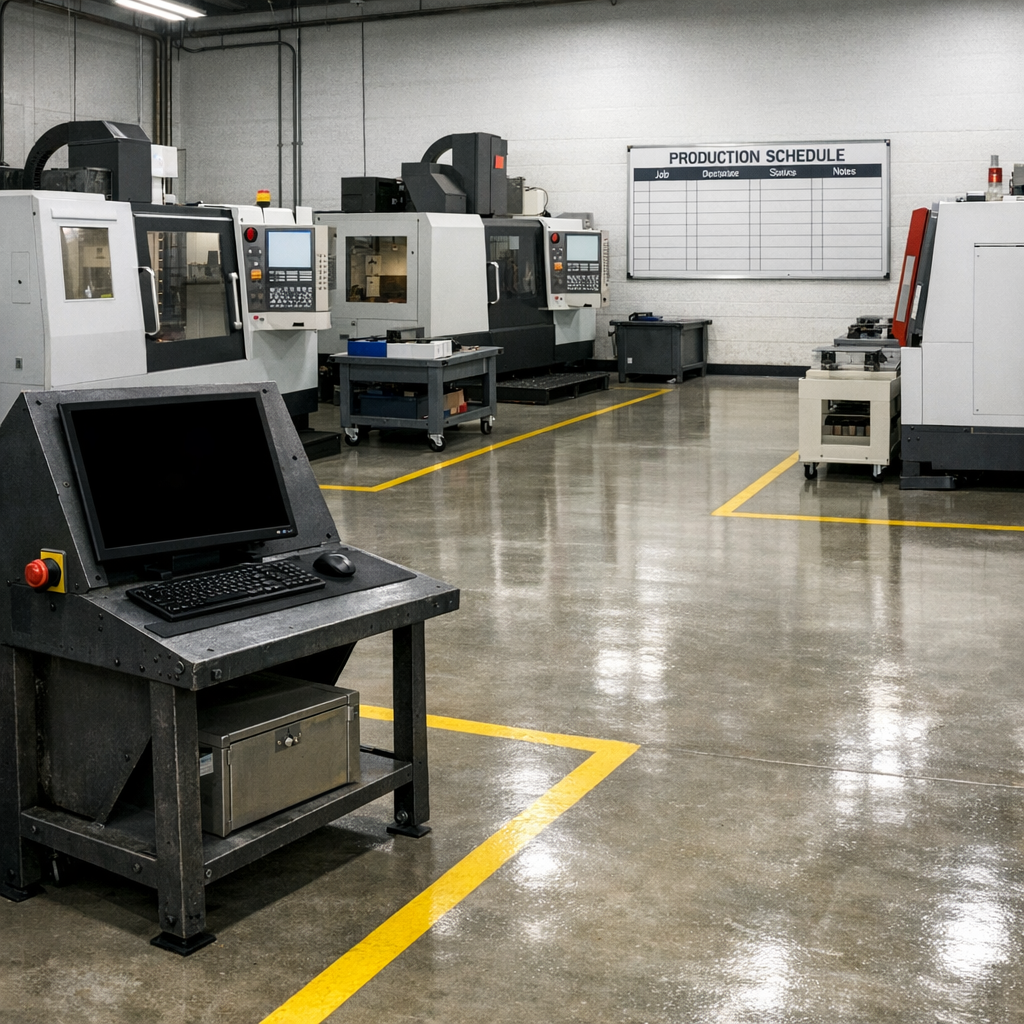
Certainly, as job lead times become shorter and shorter, the necessity for realistic delivery due dates becomes evermore important. For the estimator, for whom labor productivity must reinforce scheduling, the delivery due date for a job determines whether back scheduling or forward scheduling is needed to fulfill the due date quoted. Work center capacities must be ascertained and material must be ordered in consideration of the other jobs coming into the plant at the same time. For this, a Touch Screen Data Collection (TSDC) system allows both finite and infinite forecasting by work center.

Utilizing an easy to read graphical scheduling tool, TSDC job loads are measured in relation to capacity loads by shop floor work centers. In the display, colored-coded graphs reveal those shop floor areas that are “hot” with work, and those that are “cold” and could be better used to enhance overall shop floor capacity. Online updates as a result of data input by shop floor personnel provide a real-time assessment of capacity, thereby allowing for a finite forecasting of loads. (more…)

Direct/Indirect Labor Management Via Data Collection ERP Software: Part 2

Monday, August 10th, 2009

In Part 1 of this two-part series on managing labor costs through data collection, we addressed direct labor and the use of Touch Screen Data Collection tools (TSDC). In addition, we recognized the importance Graphical User Interfaces (GUI) can have with reducing shop floor employee time by the tactical placement of inter-connected touch screen monitors around an operation.

Regarding the concept of indirect labor, the TSDC also keeps track of the employee clock day in terms of the time spent in non-productive activities. While these activities include specified off-the-clock break/lunch times, such events could also include indirect labor costs for legitimate on-the-clock meetings or training. In either case, this “missing time” for employees is distributed among all shop work and included as general indirect overhead cost. The TSDC then calculates a total time that should be in productive use by an employee or work center.

In the old system of time and attendance monitoring of manufacturing shop floor operations, after a worker finished a job they may have spent considerable time going around the shop floor searching for something to do (or not do). However, with the TSDC, once a job is finished and clocked-off, the employee can then simply go to any GUI terminal and chose another task from a list of all pending shop jobs. In short, the TSDC reduces non-productive indirect labor time by centralizing tasking to online workstations that show on-going shop production needs in real-time. (more…)