

3 min read
Break down silos with unified ERP
Most manufacturers did not plan to run their business on a patchwork of tools.
Over time, a CRM system showed up for sales, a scheduling board arrived for the floor, quality built its own database to satisfy auditors and accounting kept everything balanced in a separate financial package. Each system solved a local problem, but together they left leaders asking a basic question: which version of the truth should we trust.
The cost of those silos shows up in everyday headaches. Sales promises dates based on rough capacity guesses. Planners rebuild schedules when new orders arrive because CRM and ERP do not talk. Quality finds a problem but struggles to show its impact on jobs and customers. Accounting spends days reconciling job costs and margins because labor, material and overhead do not flow from one shared backbone.
A unified ERP approach replaces that maze with a single operational story. Instead of five systems each holding a slice of reality, one AI-integrated platform manages CRM, quoting, orders, scheduling, material planning, quality and accounting. Data moves once and stays in sync.
This shift is playing out across the industry. SME’s blog, "The Impact of ERP Systems on Manufacturing," describes how integrated ERP breaks down silos so teams can move faster and make better decisions. For manufacturers, the payoff is simple but powerful: everyone from the first quote to final invoice works from the same facts. That means fewer errors, cleaner handoffs and more time spent improving flow instead of arguing over which spreadsheet wins.
Build ERP workflows that mirror real job flow
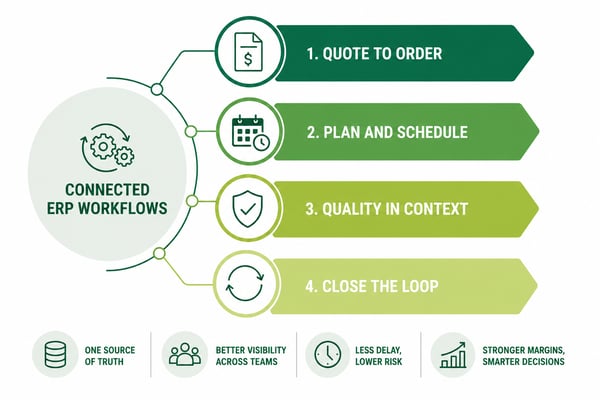 Designing connected ERP workflows that mirror how jobs really flow means following the life of an order from prospect to paid invoice and making sure each handoff happens just once in the system.
The problem in many plants is not that they lack data; it's that the same data is retyped into CRM, spreadsheets, quality logs and accounting systems. Every re-entry adds delay and risk, therefore you need to begin at the top of the process.
When sales or estimating quotes a job, they should pull items, routings and price logic from the same ERP data that production and accounting use. That way, the routing that drives the quote is the same one that plans the schedule and executes the cost rollup. When the customer says yes, the quote should convert into a sales order and then into a work order without anyone rekeying part numbers or dates.
Next, connect scheduling and material planning. As orders land, ERP should load work against real capacity and explode material demand into time-phased requirements for purchasing. Planners see dispatch lists by workcenter and finite load charts; buyers see demand by item and supplier. When sales changes a due date, both functions see it in the same place instead of through a long email chain.
Quality needs a direct seat in this workflow, as well, not on an island of its own. Inspections, nonconformances and corrective actions should attach to the specific work orders, operations and supplier lots they affect. When scrap rises on a key family, both production and finance should see the impact without building a custom report from scratch. When a customer complaint comes in, customer service should be able to pull the entire history of that lot from inside the ERP.
Finally, close the loop with accounting. When jobs ship, ERP should automatically update finished goods, cost of goods sold and revenue based on the same transactions operators and buyers already touched. Accounts receivable, payables and margin reports all draw from one version of the truth. Leaders can then make decisions based on accurate, timely data instead of reconciling multiple systems.
Roll out erp in phases
Rolling unified ERP out in phases the plant can absorb is the difference between a smooth transition and a painful reset. Trying to switch every department and process at once may look good on a slide, but it rarely survives first contact with the floor.
 Start with one area of the business where better visibility would make an immediate difference. Choose a process that connects key parts of the operation, such as quoting, order entry, production, quality, shipping and invoicing. Bring the right people into the conversation early so sales, operations, quality and finance understand what's changing and how their work connects.
Keep the first phase focused. Instead of trying to turn on every feature at once, start with the core workflow your team needs to run the job from quote to shipment. Make sure items, routings, work orders, inspections, shipments and invoices are flowing through the system the right way before expanding into more advanced tools.
Measure a few simple KPIs before and after the change so you can see what's working. On-time delivery, quote-to-order conversion, first-pass yield and margin by job are good places to start. Expect the first few weeks to reveal rough spots, then use that feedback to adjust routings, lead times, customer information and quality checklists so the system better reflects reality.
Once that first area is running well, expand into more products, departments, plants or business units. Add deeper quality tools, CRM automation and advanced planning and scheduling after the basics are stable. A phased approach helps your ERP become the backbone that connects sales, production, quality and accounting without overwhelming the people who keep the plant running.
Bring it all together
When your data, workflows and teams are connected, ERP becomes more than a system of record — it becomes the way your shop runs smarter. Take a Product Tour of the Global Shop Solutions applications to see how an AI-integrated ERP system brings together CRM, scheduling, quality, accounting and more.