

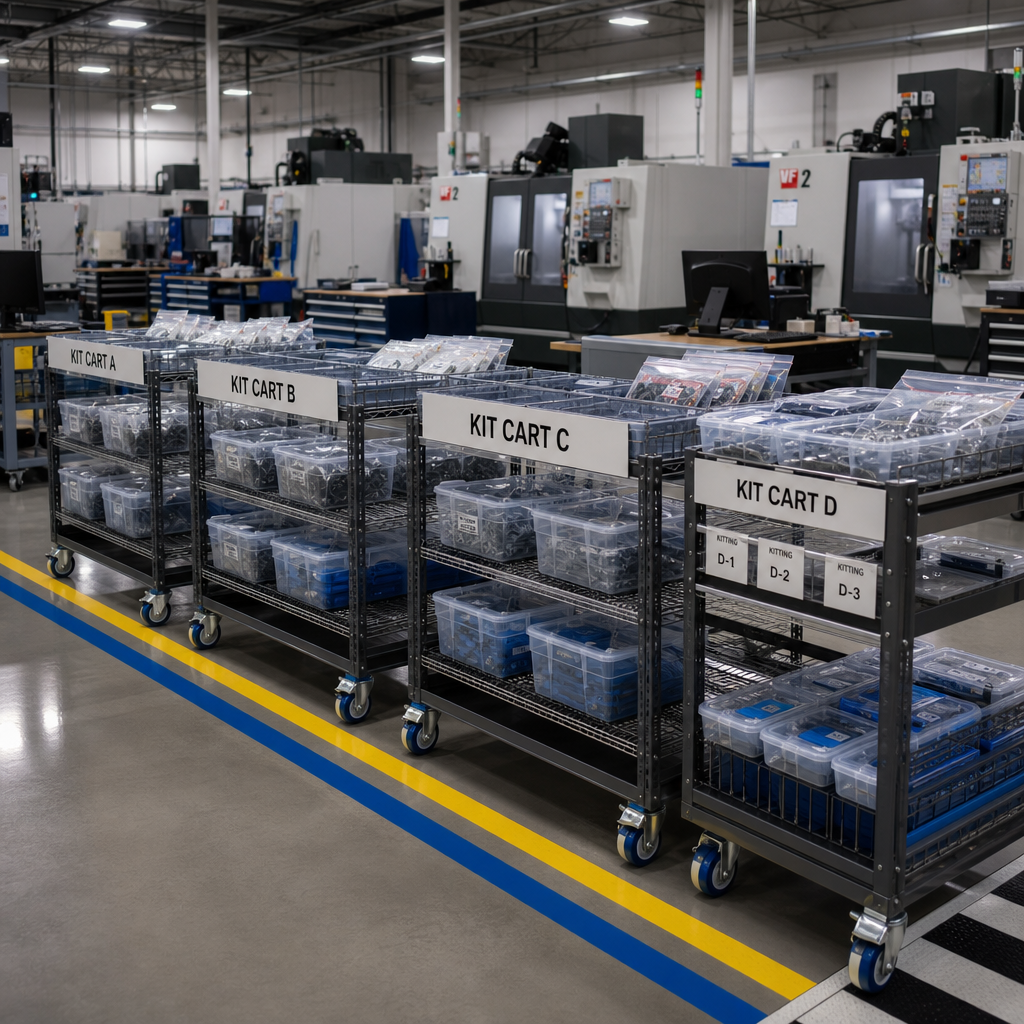
Treat missing material as a production problem, not bad luck
Most plants lose more time to missing material than to broken machines. A machinist waiting on a $3 insert, a welder looking for a specific bracket, a team leader hunting for the right fixture all add up to lost capacity and frayed nerves.
Those delays rarely show up on a report, yet they quietly chew through your promise dates. The fix is not to yell louder or stack more stock on the racks. The fix is to make sure every operation has what it needs before the spindle stops. That is the job of kitting and pre-stage built on top of clean ERP data.
Walk your floor and watch what happens in the last 10 feet before the machine. Do operators have everything they need when they are ready to press start, or do they improvise around shortages and unclear staging?
Ask where they lose time. You will hear the same pains:
- Missing hardware
- Half full bins
- Travelers that do not match what is in the cart
ERP gives you the tools to turn that noise into flow. When item masters, routings and work orders live in one system, you can tell it exactly which pieces belong in each kit and when that kit should be ready. Kitting then becomes a standard process, not a daily scramble.
Industry writers have seen this story play out. SME’s The Impact of ERP Systems on Manufacturing calls out integrated planning, inventory and execution as a major lever for productivity. When you treat missing material as a production problem instead of bad luck and when you run kitting from your ERP backbone, you turn quiet minutes of lost time into visible, fixable issues. The payoff is a quieter plant, faster changeovers and customers who notice that you keep your promises.
Run kitting and staging directly from your ERP backbone
Kitting really pays when it lives in the same system that runs your orders, inventory and schedule. When ERP drives what to pick, when to stage and where to park each kit, people stop guessing and start pulling carts with confidence. When kitting depends on spreadsheets and hand-written notes, even the cleanest layout will still leave operators hunting.
Start by defining kit structures that match how you actually build parts. For high-mix shops, that often means operation-level pick lists tied to the routing rather than one big list at the job header.
Each kit definition should call out everything the operator needs at that step:
- Raw material
- Purchased components
- Fasteners
- Inserts
- Fixtures
- Gauges
- Paperwork
Build these structures as reusable templates in ERP so planners do not reinvent them for every order.
When a work order releases, the system should automatically generate pick lists and kit labels. Material handlers then work from a clear queue instead of walking racks with a traveler in hand. As handlers pick, have them scan items out of stock and into the kit, then scan the kit into a specific staging lane near the target workcenter.
That simple pattern keeps inventory accurate, protects traceability and creates a live picture of which kits are complete, short or in transit. Supervisors should be able to see that status on one screen and on physical markers in the staging area. When ERP owns kit logic, staging lanes and inventory movement, material readiness becomes a visible part of the plan instead of a daily surprise at the machine.
sustain ERP-Driven kitting with simple measures and habits
The hardest part of any material program is keeping it strong after the first wave of enthusiasm fades. Sustaining ERP-driven kitting means treating it like any other critical part of your production system: measured, reviewed and tuned in plain language.
Decide first what good looks like. For most plants, that means near-zero shortages on priority items, kits staged before the machine stops and very few last-minute runs back to the crib. Translate those goals into a small set of measures you can pull straight from ERP:
- Kit completeness at release
- Shortages per hundred work orders
- Hours of machine downtime waiting on material
- The number of hot list calls from the floor
Publish them in the kitting area and in daily production reports so everyone sees the same facts. Use short, regular meetings to keep the numbers moving. A daily 10-minute huddle in the staging area reviews yesterday’s misses and today’s risks. The team looks at which kits went short, why and what to change. Maybe a bin label was wrong, maybe a vendor slipped or maybe the kit definition missed a common insert. Capture the root cause in the system so patterns appear over time. Once a week, bring operations, purchasing and inventory together to review trends instead of one bad shift. When shortages for a component spike, adjust min max rules or lead times. When a constraint machine frequently runs without a next kit staged, revisit how far ahead you pre stage and whether staffing matches the work.
Industry groups echo this connection between material flow and plant performance. The National Association of Manufacturers, through its Manufacturing Leadership Council, notes in Digital Transformation Sees Explosive Growth that leading plants focus on end-to-end flow, not just machine speed.
Keep mechanics simple: clear labels, color-coded lanes and uncluttered screens. The easier it is to do the right thing, the more your team will keep ERP in sync with reality and your machines fed with the right material at the right time.
in Conclusion
Successful kitting and staging are not about adding more inventory or creating more work for the floor. They are about ensuring material arrives where it is needed, when it is needed and with complete visibility through your ERP system. By treating material readiness as a core production function, standardizing kitting processes and sustaining performance through simple measurements and daily discipline, manufacturers can reduce downtime, improve throughput and deliver more consistently on customer commitments.
READY TO SEE THESE IDEAS IN ACTION?
Take a self-guided tour of our AI-enabled ERP software applications.