

4 min read
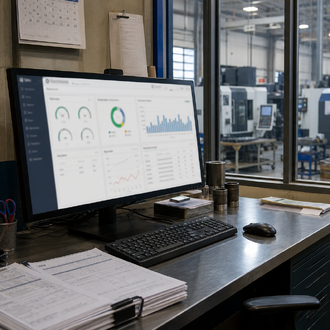
Finance leaders in manufacturing are under pressure from every direction. Owners want higher margins and faster growth. Banks and investors want cleaner covenants and predictable cash. Customers want tighter promises at aggressive prices.
At the same time, many plants are still wrestling with volatile demand, supply chain swings and labor shortages. In that environment, vague pitches about “AI-powered finance” do not help. Clear, trustworthy signals do.
Use ERP data to define AI signals that matter to finance
For discrete manufacturers running on an ERP like Global Shop Solutions, those signals already live in the data. Every quote, work order, receipt, scrap event and invoice leaves a trail. The challenge is not access; it is attention. Humans can only stare at so many variance reports, cash forecasts and dashboards before their eyes glaze over. AI becomes useful when it helps finance leaders focus on the few numbers that truly move the business instead of throwing more charts at them.
The key is to keep the conversation where your plant already works – inside ERP. Global Shop Solutions has spent decades turning shop-floor reality into job costs, inventory positions and margin reports. Recent evolutions into AI-enhanced ERP, highlighted on pages like AI-Integrated ERP Software and Best ERP Software for Manufacturers, focus on adding intelligence to that backbone, not replacing it. For a CFO or controller, that means thinking of AI less as a new system and more as a set of “tells” about the health of cash, risk and margin – delivered in the tools you already use.
Instead of an abstract promise that “AI will optimize working capital,” you want alerts that:
-
Show which customers are quietly stretching payment terms
-
Highlight products and value streams whose margins are drifting
-
Surface inventory patterns that signal future write-offs or stockouts
-
Flag when planned capacity and mix will push overtime or underutilize critical machines.
External market coverage is heading in the same direction: use AI to turn noisy operational history into a smaller set of actionable insights. Manufacturing finance leaders can design those insights on top of ERP data, then turn them into simple habits that protect margin and cash without overwhelming the plant.
Design AI helpers on top of ERP data, not outside it
 Most manufacturers do not suffer from a lack of data. They suffer from finance teams drowning in it. ERP has decades of history on jobs, customers, suppliers and cash, but leaders still end up exporting everything to spreadsheets. That is where many AI conversations go wrong.
Vendors pitch separate analytics platforms, robotic advisors or generic “financial AI” tools that live outside the system that actually runs the plant. A better path starts with simple helpers built directly on top of ERP data that finance and operations already trust. Instead of throwing another dashboard at the CFO, you add AI where it can see the whole quote-to-cash story and surface patterns humans miss. That means treating Global Shop Solutions ERP as the backbone and letting AI read from and write to that backbone rather than copying data into side systems.
At a minimum, manufacturing CFOs can use three families of helpers: First, variance explainers. Classic job-cost and margin reports show which orders missed their targets; AI can help explain why. By scanning history across workcenters, part families, shifts and suppliers, a model can suggest likely causes when a job’s actuals stray far from plan. Instead of a red number and guesswork, you get prompts such as “setup over standard on Op 20 at CNC Cell 3 for similar parts” or “scrap spike tied to Supplier B’s material lots.” That turns reviews into targeted conversations with operations instead of long forensic digressions.
Second, early-warning signals on working capital. Cash pain rarely appears overnight. It creeps in through lengthening DSO, slipping supplier terms and rising WIP days. An AI helper that lives on top of your ERP AR, AP and inventory data can highlight customers whose payment behavior is drifting, POs that routinely miss agreed dates and items that flip between stockouts and overbuys. Blogs like Inventory Accuracy in Manufacturing: How to Stop Stockouts and Overbuying already show how ERP data reveals these patterns; AI simply helps surface them faster and in plainer language.
Third, forecast sanity checks. Finance teams live with revenue and margin forecasts that feel more aspirational than realistic. By comparing planned sales mix against historical margin by customer and product family, an AI assistant can flag projections that lean too heavily on low-margin work, risky buyers or constrained machines. It does not replace the budget process; it questions it with evidence pulled straight from ERP history.
Keep AI-finance habits simple so wins stick
The first wave of AI in finance often fails because it arrives as a project, not a habit. A model gets trained and demoed, then slowly drifts into the background when it does not match how people actually work. To make AI signals something your finance team and plant leaders rely on, keep the mechanics simple and the routines tight.
Start with a short list of metrics that prove value. For this kind of ERP-centric AI, focus on margin variance above a certain threshold, the number of jobs with unexplained cost swings, days sales outstanding for key customers, and the frequency of inventory write-offs or emergency buys. Pull baselines from your existing Global Shop Solutions ERP reports, then track how those numbers move after you introduce AI helpers.
Next, build a light cadence around the insights. A weekly finance–operations review can walk through a handful of AI-flagged items: jobs with unusual variances, customers whose payment behavior shifted, or items whose inventory patterns look unhealthy. For each one, the team decides whether the issue is master data (bad routings, wrong lead times or rates), execution (missed scans, unusual scrap) or genuine business risk (a customer in trouble, a supplier sliding). The fix then lives where it always should have – in updated ERP settings, customer terms or sourcing strategies.
External guidance backs up this measured, governance-first approach. The National Institute of Standards and Technology (NIST) emphasizes, in its Industrial AI work summarized at Artificial Intelligence: Key Consideration and Effective Implementation Strategies, that manufacturers should anchor AI projects in specific pains, clear data ownership and human accountability. That is exactly what finance leaders already do when they sign off on new policies or tooling.
Finally, keep the story grounded on the shop floor. When AI spots a margin problem early or flags a risky inventory pattern, close the loop by showing supervisors and buyers what changed on their side to keep the plant out of trouble. Maybe a routing tweak on the constraint machine brought a tough product family back into target margins. Maybe tightening min/max rules on a chronic problem item cut both stockouts and overbuys. Sharing those wins in language that machinists and schedulers care about – fewer fire drills, more predictable shifts – makes AI feel like a partner, not an auditor. Over time, this steady, ERP-centered approach turns AI into something your finance team and plant trust. Instead of chasing hype, you get a set of practical signals that protect cash, margins and risk using the data you already own.