

4 min read

Here’s the dirty truth about ‘good margins.’ You can run a clean shop. You can ship on time. You can make beautiful parts.
And still lose money.
Because in manufacturing, profit rarely disappears in one dramatic explosion. It leaks. Quietly. Relentlessly. One quote at a time.
It leaks when:
- You underprice a job because you “want to win it.”
- Material costs spike mid-run and nobody adjusts
- Overtime shows up like a surprise guest, and nobody accounts for it
- Your overhead allocation is guesswork, and your pricing is basically vibes.
Then you wake up at the end of the quarter wondering how you stayed busy all month but barely moved the needle in the bank account.
You do not win by being busy. You win by being profitable on purpose.
If you want to lead, not survive, you need a system for costing, pricing and margins that stays accurate when labor changes, material prices spike, scrap shows up uninvited and customers start pushing discounts like it’s a sport.
tHE REAL PROBLEM IS NOT COST. IT'S COST VISIBILITY.

Most manufacturers think they know what something costs. They do not. They know what it costs on paper, in theory, in last year’s spreadsheet, in somebody’s head. Real costs move. Hour by hour. Shift by shift. Run by run.
Direct materials fluctuate. Labor is not just an hourly rate. It is overtime, training, turnover and the productivity drop that follows churn. Overhead is not a flat fee. It is equipment utilization, downtime, setup time and the hidden tax of inefficiency.
When those costs are misallocated or delayed, pricing becomes disconnected from reality. That is where “good margins” die.
And if you are serious about winning, you cannot let profitability be a mystery you solve at the end of the job.
PRICING: THREE APPROACHES, THREE WAYS TO GET HURT
There are three common pricing strategies. Each one has a place. Each one can wreck you if you use it blindly.
1. Cost-Plus Pricing. Cost-plus pricing feels disciplined, structured and predictable. It is also dangerously incomplete. Cost-plus ignores demand. It ignores competitive pressure. It ignores willingness to pay. It assumes your customer cares about your internal math. They do not.
2. Competitive Pricing. Competitive pricing helps maintain volume. It can protect market share. But if you do not have tight cost control, competitive pricing becomes a slow-motion margin collapse. You win the quote and lose the job financially.
3. Value-Based Pricing. Value-based pricing is where the best operators live. It is not “charge more because we feel like it.” It is pricing based on the measurable value the customer receives. That value might be:
- time saved
- scrap reduced
- energy efficiency gained
- uptime increased
- compliance risk avoided
Value-based pricing can increase revenue without crushing volume, but it requires a serious understanding of your costs and your customers' economics.
MARGIN LEAKS: THE QUIET EXECUTION FAILURES THAT DESTROY PROFIT
Margins rarely disappear in one moment. They disappear between quote and delivery.
They disappear through:
- inaccurate labor assumptions
- overtime spikes
- scrap and rework
- expediting materials
- change orders that never get billed
- support-heavy customers that never pay for the chaos they create
Pricing too high loses sales. Pricing too low trains customers to expect discounts. Aggressive discounting destroys long-term pricing power and makes your next negotiation weaker before it starts.
And here’s the one that separates average from elite:
If you cannot identify unprofitable products and unprofitable customers, you will keep feeding them.
The best manufacturers do not just make parts. They make decisions based on profit truth.
THE SMART PLAY: CUSTOMER PERCEIVED VALUE WITH REAL NUMBERS BEHIND IT
If you want to lead, you need to stop pricing like a commodity supplier.
Customer Perceived Value is the customer’s evaluation of what they get versus what they pay. Here is how elite manufacturers build pricing power without guessing:
- Know the customer’s process. How do they use your product? What fails without it? What delays without it?
- Find the value drivers. Where do you save them time? Where do you reduce waste? What risk do you eliminate?
- Quantify the impact. What is that worth in labor savings, material savings, uptime and avoided downtime?
- Build a value proposition that cannot be ignored. Not “we are great.” More like: “Here is what changes when you use us.”
- Set a price that leaves value on the table for them and real profit for you. Customers need to win too. The difference is you stop winning by surrendering your margin.
That is value-based pricing done right.
PROFIT VISIBILITY: THE LINE BETWEEN CONTROL AND GUESSWORK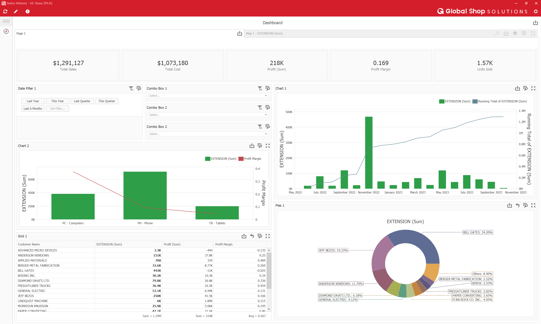
Profit visibility is what happens when quoting, production, purchasing, scheduling and financials all connect. It creates a digital thread from quote to cash. It shows you exactly where profit is created and exactly where it gets crushed.
You can segment pricing by customer type, by complexity, by channel and by true cost structure. ERP gives you the data and visibility to eliminate the guesswork.
That is not a “nice to have.” That is operational dominance.
FOUR MANUFACTURERS WHO TOOK PROFIT SERIOUSLY
-
C.E. Smith manufactures outdoor sporting goods products, fabrications and assemblies. They used to manually trace everything through the plant. Now ERP automatically determines costs so they can monitor runs when material costs fluctuate rapidly. That gives them the ability to respond faster in the marketplace with quoting and pricing.
-
Buffalo Filter manufactures surgical smoke evacuation equipment used during surgical procedures. They selected ERP for its ability to accurately capture labor costs and manage inventory. Having information in one place helps define true costs and improves quoting for new projects.
-
Arc Design, Inc. is a metal fabricator specializing in parts for oil drilling structures. They used to see costs, margins and profits at the end of each project. Now they track and control everything from beginning to end. When a job finishes, they know what it cost, whether they made money and how much. That ability to budget, estimate and control project cost helps them compete more effectively.
-
Staber Industries manufactures energy-efficient washing machines and drying cabinets. After implementing ERP, they saw their true costs for the first time. With accurate hourly labor rates, overhead and equipment costs entered, the system delivers accurate accounting of true costs. That tells them how far they can lower price and exactly where the line is before they say no.
READY TO QUOTE WITH CONFIDENCE AND PROTECT YOUR MARGINS?
If you want to stop guessing and start pricing with precision, it starts with visibility. Global Shop Solutions ERP helps manufacturers calculate true costs, tighten quoting, protect margins and track profitability from quote to cash. Schedule a demo and see what changes when your pricing is backed by real data, real execution and real control.