

5 min read

Your accounting software and scheduling spreadsheets worked fine when you started. But lately, you've noticed the cracks: mismatched inventory counts, reports that take hours to pull together and your team creating workarounds just to get through the day. These are signals that basic tools have hit their ceiling, and it's time to move to an integrated ERP system.
This guide walks you through the operational warning signs that indicate your current software is restricting growth. You'll learn specific thresholds and symptoms to watch for, plus actionable next steps to position your manufacturing operation for scalability.
Why Basic Accounting and Scheduling Tools Eventually Hit a Wall
Entry-level accounting packages and standalone scheduling tools are designed for simplicity. They handle invoices, track expenses and let you manage basic production timelines. That works well when you're running a small operation with predictable workflows.
The trouble starts when your business grows faster than your software can adapt. According to ERP Advisors Group, common pain points include lack of robust internal controls, limited reporting capabilities and systems that can't keep pace with transaction volumes.
For manufacturers specifically, the stakes are higher because, in addition to tracking dollars, you're managing raw materials, work-in-progress (WIP), labor costs, machine capacity and customer delivery commitments. When those elements live in separate, disconnected systems, problems multiply fast.
7 Warning Signs Your Software Is Limiting Manufacturing Growth
Here are the clearest indicators that your current accounting and scheduling tools have become obstacles rather than assets.
1. Your Data Lives in Silos
If your accounting team uses one system, production uses another and sales relies on spreadsheets, you've got data silos. This fragmentation means no one has a complete picture of your operation.
You end up reconciling numbers manually between systems, which eats up hours and introduces errors. When a customer calls asking about order status, you have to check three different places before giving an answer.
2. Reports Take Hours (or Days) to Assemble
Basic accounting software offers canned reports that work for simple financial statements. But when you need to analyze job profitability, track WIP costs or evaluate on-time delivery rates, you're pulling data into Excel and building reports from scratch.
This manual effort delays decision-making. By the time you've assembled the numbers, they're already outdated. A fully integrated ERP software should provide real-time dashboards and KPIs accessible from any device, giving you instant visibility into what matters most.
3. Manual Workarounds Have Become the Norm
Pay attention to how your team actually works. Are they maintaining shadow spreadsheets to track inventory? Writing notes on paper travelers because the system can't capture what they need? Sending emails to coordinate schedules because the software doesn't support collaboration?
These workarounds are symptoms of software that no longer fits your operations. They also introduce risk caused by human error, such as a mistyped number in a spreadsheet that can throw off inventory counts or lead to missed deliveries.
4. Inventory Counts Never Match Reality
Basic accounting packages treat inventory as a financial asset to track, not a manufacturing resource to manage. They can't account for materials allocated to jobs, WIP quantities or lot-level traceability.
As a result, you end up with phantom inventory – parts the system says you have but aren't actually on the shelf. Or you order materials you already have because no one trusts the numbers. With an integrated ERP, you can connect inventory to production in real time, so counts reflect what's actually happening on your shop floor.
5. Scheduling Decisions Are Based on Gut Feel
Standalone scheduling tools or Excel-based capacity planning can handle simple scenarios. But as your job mix gets more complex, they fall short.
You can't easily see true machine capacity, factor in setup times or identify bottlenecks before they cause delays. Production managers end up making scheduling decisions based on experience and intuition rather than data. This leads to missed due dates, excessive overtime and frustrated customers.
6. Quoting Takes Too Long and Accuracy Suffers
When your estimating process relies on tribal knowledge and historical guesses, quotes become unreliable. You either underbid (killing your margins) or overbid (losing work to competitors).
Accurate quoting requires access to actual job costs, material prices, labor rates and historical performance data. If those elements live in disconnected systems, putting together a competitive quote becomes a time-consuming research project.
7. Growth Feels Risky Instead of Exciting
Here's the most telling sign: you hesitate to pursue new opportunities because you're not sure your operation can handle them. A big order comes in and, instead of excitement, you feel anxiety about whether you can deliver.
This growth ceiling often comes from limited operational visibility, not from how much capacity you have. Without integrated systems, you can't confidently assess whether you have the resources, materials and shop floor bandwidth to take on more work.
The Thresholds That Signal It's Time to Act
Recognizing the warning signs is step one. But when should you actually make the move to integrated ERP? Here are a few specific thresholds to consider.
-
Transaction Volume: Most basic accounting packages start struggling when you exceed certain limits – typically around 25-40 concurrent users or high transaction volumes that slow system performance. If month-end close takes longer than it used to, or daily operations feel sluggish, you're likely hitting these limits.
-
Operational Complexity: When you're managing multiple locations, handling multi-currency transactions or dealing with complex intercompany requirements, basic tools require extensive workarounds. If your accountant spends more time manipulating data than analyzing it, complexity has outpaced your software.
-
Customer Expectation: Your customers are asking for things your current systems can't deliver: real-time order status, lot traceability documentation, quality certifications or EDI integration. Meeting these expectations with basic tools means manual effort that doesn't scale.
-
Competitive Pressure: Your competitors are quoting faster, delivering more reliably and winning business you used to get. They likely have better visibility into their operations – visibility that integrated ERP enables.
What Integrated Manufacturing ERP Actually Changes
Moving from disconnected tools to integrated ERP isn't just a software upgrade. It fundamentally changes how you operate.
For example, Global Shop Solutions ERP connects all your manufacturing data into one single source of truth. From scheduling, shop floor and inventory to purchasing, accounting and CRM, all applications are connected within one unified system. When you look up a job, you see materials allocated, labor recorded, quality inspections completed and costs accumulated. No more hunting through multiple systems.
Dashboards provide real-time visibility into what's happening right now and with Dashboard Designer you can design, customize, track and display data in formats that meet your unique business needs. Shop floor data collection captures labor and machine time as it occurs. Inventory updates instantly when materials are issued or received, helping you make decisions based on current reality, not yesterday's reports.
Then purchasing triggers automatically when inventory hits reorder points. Work orders flow from sales orders without rekeying and quality holds prevent non-conforming parts from shipping. These automated workflows eliminate manual handoffs and reduce the risk of errors. Finally, when labor, materials and overhead accumulate against jobs in real time, you know exactly which work is profitable and which isn't. Global Shop Solutions integrated ERP gives you precise job costing that reveals your true margins so you can quote confidently and price strategically.
Making the Move: Practical Next Steps
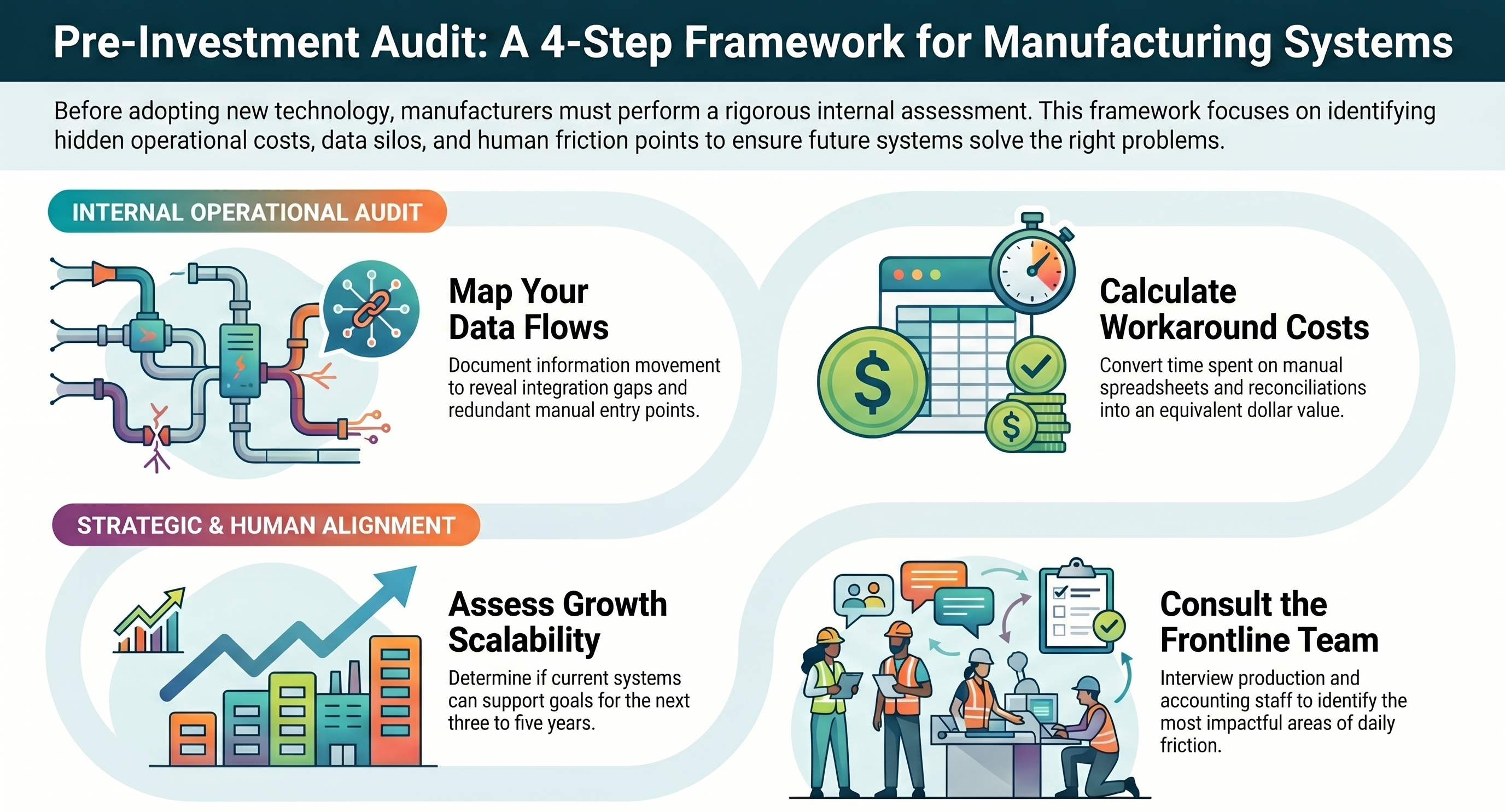
If you've recognized multiple warning signs and hit several thresholds, here's how to move forward thoughtfully.
-
Document Your Requirements: Before evaluating any ERP system, clarify what you need. Focus on the specific problems you're solving – don't get distracted by features you'll never use. Manufacturing-specific capabilities like shop floor data collection, advanced scheduling and lot traceability should be priorities.
-
Prioritize Integration: The whole point of moving to ERP is to eliminate data silos. Look for systems where modules genuinely share data, not just bolt-on applications that require separate integrations. Global Shop Solutions offers over 35 applications from quote to cash, all built to work together.
-
Plan for Implementation Success: ERP implementations succeed when you invest in training and change management. The technology is only as good as the people using it. Look for ERP vendors who offer robust in-house training programs and implementation support.
-
Consider Your Deployment Options: Cloud and on-premise options both have advantages. Cloud deployments reduce IT burden and enable anywhere access. On-premise installations offer maximum control. Global Shop Solutions supports both models, so you can choose what best fits your operation.