

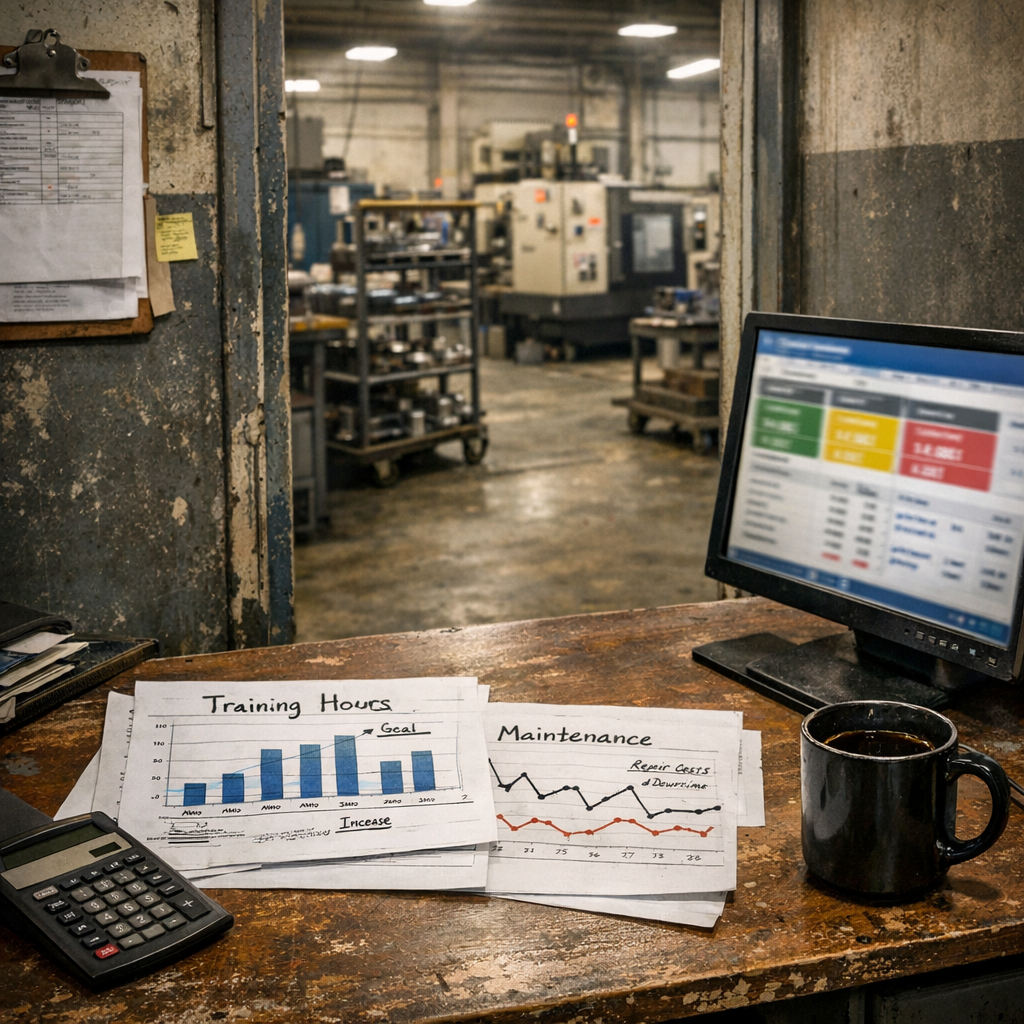
Map where ERP money really goes after go live
Most ERP cost conversations stay stuck on the initial quote. License, hosting and implementation numbers get three rounds of review. Once the system goes live, the spend quietly shifts. Annual fees tick up, add on tools creep in and the plant keeps asking for tweaks that feel small until the invoice arrives.
Leaders start to see ERP as a bottomless pit instead of a lever for profit.
The real number you need to manage is total cost of ownership. That includes software and hardware, of course, but also consulting, internal admin time, training, custom reports, data cleanup projects and all the shadow systems that pop up when people do not trust the data. Some of those costs create real value. Others simply backfill process issues that ERP could solve if it were set up and used well.
Start by making the invisible visible.
-
Pull the last 12 to 24 months of ERP related spend into one simple picture. Include vendor invoices, internal IT wages allocated to ERP, overtime for cutovers or upgrades and even time your best supervisors spend helping “fix the system.”
-
Group it into buckets such as platform, integrations, reporting, training, and firefighting.
-
Next, layer that cost picture against what the system actually runs today. List core processes that sit inside your ERP: quote to cash, scheduling, purchasing, inventory, quality, maintenance, job costing.
-
For each, ask how much work still lives in spreadsheets and tribal knowledge. When you see high spend in an area that still runs on side tools, you have found a prime candidate for redesign.
Technology only pays off when it supports better processes. Use that mindset here. Your goal is not to squeeze every dollar out of ERP; it is to keep investing where it improves flow and margin and to stop paying for workarounds that hide deeper problems.
Tackle hidden ERP costs in training, data and customizations
Once you see where the money really goes, you can start closing the leaks that do not help the plant. Three areas usually pay off fastest: training, data and customizations.
Training looks expensive on paper but cheap compared to slow adoption. Many plants rely on a single super user to “figure it out” and teach others in spare moments. That saves travel dollars but piles on risk. When that person leaves, you buy their knowledge back in consulting hours. A better move is to budget for structured training aimed at roles, not just features. Planners learn deep scheduling and what if tools. Supervisors learn dispatch, WIP control and basic KPI dashboards. Operators learn clean barcode habits. Finance learns how job costing and inventory decisions flow through ERP. Set a simple rule: no new module or major change goes live without a short, focused training plan tied to measurable usage. If you're a customer, you can track adoption right in Global Shop Solutions ERP with dashboards that show which screens people actually use. If a fancy report never gets opened, you know where to stop investing.
Data problems rack up hidden costs every day. Bad item masters cause buying errors and excess stock. Sloppy BOMs and routings drive wrong promise dates and ugly surprises in capacity. Inaccurate labor and scrap entry makes every cost report a debate instead of a decision. Cleaning this up feels like overhead, but it is the foundation that lets you use more of what you already own. Use a simple lean mindset: focus on what hurts customer lead time, quality, and margin. NIST lean and process improvement guidance lays out proven ways to map where time and effort go. Pair that with ERP. When a value stream map says delivery dates slip because of missing or wrong material, tie a data cleanup project to item masters, vendors, and reorder rules instead of buying another expediting tool.
Customizations deserve special scrutiny. Every one of them can become a hidden tax when you upgrade. Some are strategic and worth it. Many exist because the plant never learned a standard feature or did not want to change a habit. Build a short catalog: what each customization does, who uses it and what happens if it disappears. Rank them by impact on delivery, cash and compliance, not by how loud someone shouts. Then remove or replace the weak ones with standard ERP features. Fewer custom pieces mean lower maintenance bills and easier upgrades.
Keep ERP agile so costs stay under control as your plant evolves
Controlling ongoing ERP cost is not a one time cut; it is a steady management routine that keeps spending lined up with plant reality.
Think of it as your ERP continuous improvement loop. Set a simple review calendar. Once or twice a year, pull together operations, finance, IT and a couple of power users. Look at three things: what you pay, what you use and what value you see. License and hosting fees, consulting and support hours, internal admin time and training all belong on the table.
Then line those numbers up with business results such as on time delivery, inventory turns, scrap, and labor productivity. When you see a gap between spend and outcome, ask whether the issue is usage or fit. If your ERP has a module you own but do not use, adoption work may be cheaper than new software. If users live in spreadsheets for planning, maybe they need a short path from ERP data into the tools they trust for analysis, instead of a brand new reporting stack.
Keep ERP decisions close to the plant. Finance will always care about the bill, but the people who live with the system every shift know which changes will protect throughput.
Build a simple voting system where each proposed change or purchase gets scored on impact to customers, impact to employees, and cost. Give extra weight to anything that reduces chaos on the floor. Industry groups and manufacturing extension partnerships can help you benchmark. Local centers work with manufacturers on lean, technology adoption and cost control. Many have seen dozens of ERP projects and can tell you what pays off for shops like yours.
The goal is not to starve ERP; it is to feed the parts that help you deliver quality parts on time every time, and trim the ones that do not. When you keep that focus, your ERP budget stops drifting and starts acting like any other investment in equipment or people.
READY TO SEE THESE IDEAS IN ACTION?
Take a self-guided tour of our AI-enabled ERP software applications.