

3 min read

Sustainability has become one of the most overused words in manufacturing. Everyone claims to be reducing waste, improving efficiency, lowering their footprint, supporting cleaner operations.
The problem is not intent. The problem is proof.
Manufacturers are under growing pressure from customers, regulators and internal leadership to demonstrate real progress. At the same time, margins are tight and tolerance for “feel-good” initiatives that don’t deliver financial return is low.
The manufacturers getting this right aren’t chasing sustainability programs. They’re tightening operational discipline. They’re reducing waste because it costs money. They’re improving efficiency because it protects margin. Sustainability becomes the outcome, not the goal.
Below are six sustainability claims manufacturers make every day that can’t rely on estimates, assumptions or good intentions anymore.
1. “We Don’t Waste Much Material”
 Material waste hides in plain sight. Offcuts, scrap, rework and over-issuing often get written off as the cost of doing business. Guessing how much material is actually being consumed versus planned makes it impossible to improve.
Accurate inventory management tied directly to bills of material shows where waste is introduced, not just where material disappears. When actual usage is compared to planned usage by job and by operation, patterns emerge quickly.
A metal fabricator in the Southwest United States believed scrap was under control until real-time inventory and BOM tracking exposed consistent over-issuing at specific workcenters. Fixing the process reduced material costs and waste at the same time.
You can’t reduce what you don’t measure.
2. “Our Processes are Already Efficient”
Efficiency claims often rely on averages and anecdotal wins. One good shift masks three inefficient ones. Labor and machine efficiency become measurable when shop floor activity is captured as work happens. Start times, stop times, setup, run and idle all tell a clearer story than monthly reports.
Shop floor control applications replace assumptions with facts. They show where time is lost, where bottlenecks form and where improvement efforts actually pay off.
Efficiency improvements reduce labor waste, energy use and overtime. Sustainability follows discipline, not declarations.
3. “Our Jobs Are Profitable and Energy Efficient”
Sustainability and profitability are inseparable. Wasteful jobs are rarely profitable jobs. Energy usage is often treated as a fixed overhead, but it varies significantly by machine, shift and process. Without tying energy-related costs to actual production activity, inefficiencies remain hidden.
Job costing applications connected to real labor, material and workcenter data reveal where margin erodes due to scrap, rework or inefficient energy use. Instead of discovering problems after the job ships, manufacturers can see them while there’s still time to act.
One ERP customer, a precision manufacturer in the Midwest United States, uncovered that certain low-volume jobs consistently consumed more machine time and energy than expected. With accurate costing and workcenter visibility, leadership adjusted pricing and processes to protect margin.
Sustainable operations are profitable by design, not by accident.
4. “Our Suppliers Meet Our Standards”
Supplier sustainability claims are only as good as the data behind them. Purchasing systems tied to vendor performance tracking allow manufacturers to evaluate suppliers based on delivery reliability, quality and material consistency. Traceability adds accountability when issues arise.
Manufacturers relying on memory or spreadsheets struggle to prove compliance and manage risk. Those using integrated purchasing and traceability respond faster, reduce exposure and limit downstream waste.
Better supplier decisions reduce disruptions and rework across the entire operation.
5. “We Don’t Carry Excess Inventory”
Excess inventory ties up cash, consumes space and increases the risk of obsolescence and waste. Automated purchasing driven by real demand replaces stockpiling with precision. When purchasing decisions are informed by live production schedules and accurate inventory levels, manufacturers buy what they need when they need it.
A contract manufacturer on the East Coast of the United States dramatically reduced obsolete inventory after replacing forecast guesses with demand-driven purchasing rules.
Less inventory. Less waste. Better cash flow.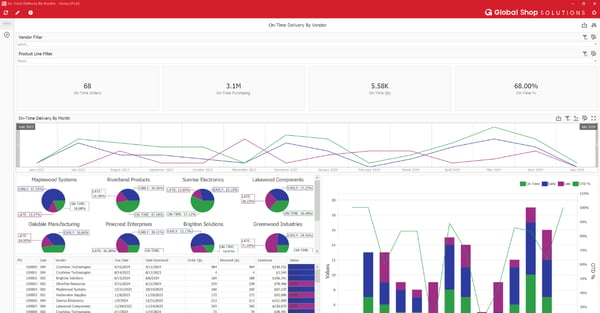
6. “We Can Prove Our Progress”
Sustainability claims increasingly require documentation.
Dashboards and KPI reporting provide consistent, defensible metrics around scrap rates, efficiency, inventory turns and cost trends. Instead of scrambling for reports, manufacturers can answer questions with confidence. Data-backed reporting builds trust with customers and regulators while guiding smarter internal decisions.
If it can’t be shown, it doesn’t count.
Sustainability Isn’t a Program. It’s an Operating Discipline.
Manufacturers don’t improve sustainability by adding more initiatives. They improve it by tightening control over materials, labor, energy and data.
ERP doesn’t make a shop sustainable. It makes sustainability measurable, repeatable and profitable.
When manufacturers stop guessing and start measuring, waste falls, efficiency rises and sustainability becomes part of how the business runs.
Want to see how manufacturers reduce waste, improve efficiency and support sustainability using accurate operational data? Explore the site to learn how integrated ERP applications support smarter, more responsible manufacturing.