

5 min read

If you're running multiple manufacturing plants, you already know the challenge: how do you prove that your shop floor management software is actually delivering value? It's one thing to feel like operations are running better. It's another to show your CFO concrete numbers that justify the investment.
Global Shop Solutions ERP helps manufacturers track ROI through real-time data collection, multi-site visibility and integrated job costing. With the right metrics, you can connect daily shop floor activity to measurable improvements in cost, capacity, delivery, quality and plant performance.
How does shop floor management software prove ROI?
Shop floor management software proves ROI by helping manufacturers collect real-time production data, improve operations management, reduce unplanned downtime, strengthen job costing, increase inventory accuracy and monitor plant performance across one location or multiple sites.
The most useful ROI metrics are measurable, tied to business impact and meaningful to both operations and financial decision-makers.
Quick guide: 11 ways to prove shop floor software ROI
Whether you're managing one facility or a dozen, here are 11 practical ways to measure and prove the return on your shop floor software investment.
- Software adoption rate: Measures how many employees actively use the system daily
- Unplanned downtime reduction: Tracks decrease in unexpected machine and production stoppages
- Production consistency: Monitors variance in output quality across facilities
- Multi-site visibility: Evaluates real-time access to data from all plant locations
- Inventory accuracy: Compares physical counts against system records
- On-time delivery rate: Measures shipments delivered by promised date
- Job costing precision: Assesses actual vs. estimated costs per work order
- Labor efficiency gains: Tracks productive hours against total hours worked
- Scrap and rework reduction: Monitors waste percentages before and after implementation
- Quote-to-cash cycle time: Measures speed from customer quote to payment receipt
- Real-time reporting access: Evaluates time to generate actionable insights
How to choose and measure the right ROI metrics
The best ROI metrics are the ones your team can measure consistently and connect to real business outcomes. Start with a baseline, track the same data over time and focus on metrics your team can influence through better visibility, training and process improvements.
The fastest areas to measure are software adoption, downtime reduction, inventory accuracy, on-time delivery and labor efficiency. These metrics often reveal early wins while pointing to long-term opportunities to improve manufacturing operations.
Whenever possible, translate operational improvements into financial terms. “We reduced downtime by 12 hours per month” is helpful. “We recovered 12 hours of production capacity per month, worth approximately $X annually” is stronger.
The 11 ways operations leaders prove shop floor software ROI
1. Track software adoption rates across all plants
Software adoption rate measures how many employees actively use your shop floor management software. This matters because the software only creates ROI when people use it consistently.
Track daily logins, completed transactions, job updates, inventory movements and module usage. For multi-site operations, compare adoption by plant to see where additional training or process support may be needed.
How to measure it: Active users ÷ total expected users
Why it proves ROI: Strong adoption supports better data, cleaner reporting and more reliable operations management.
2. Measure unplanned downtime reduction
Unplanned downtime affects output, labor utilization, delivery dates and revenue. When machines go down unexpectedly, production slows or stops, and teams often lose time trying to understand the cause.
Shop floor management software helps teams track machine status, downtime reasons, maintenance needs and recurring issues. Compare downtime hours before and after implementation, then estimate the value of recovered production time.
How to measure it: Reduced downtime hours × hourly production value
Why it proves ROI: Downtime reduction shows the software is helping recover capacity and reduce avoidable delays.
3. Monitor production consistency and plant performance
Production consistency shows whether your manufacturing operations are producing the same quality, output and performance across jobs, shifts and locations.
Track yield rates, cycle times, first-pass quality, production output and schedule adherence. For multi-site operations, this helps identify which plants are performing well and where processes may need attention.
How to measure it: Compare quality rates, cycle times and output across plants, departments or shifts
Why it proves ROI: Improved consistency reduces variation, supports better planning and strengthens overall plant performance.
4. Improve visibility across multi-site operations
Without connected systems, leaders often rely on emails, phone calls and spreadsheets to understand what is happening across locations. That slows down decisions and makes it harder to compare performance.
Shop floor management software gives teams real-time visibility into job status, inventory, labor, capacity and production activity across plants. This makes it easier to answer questions about rush orders, available capacity, material availability and production delays.
How to measure it: Time previously spent gathering data − time now spent accessing data
Why it proves ROI: Better multi-site visibility speeds up decisions and reduces manual reporting.
5. Track inventory accuracy improvements
Inventory accuracy affects production, purchasing, customer promises and cash flow. When inventory records are wrong, manufacturers risk stockouts, overbuying and unnecessary production delays.
Shop floor software improves inventory accuracy by updating material usage, receiving, shipping and work-in-progress activity in real time. Barcode and RFID tracking can also reduce manual entry errors.
How to measure it: Accurate item counts ÷ total item counts
Why it proves ROI: Higher inventory accuracy helps reduce stockouts, excess inventory, emergency purchases and delays.
6. Measure on-time delivery rate changes
On-time delivery is one of the clearest signs that manufacturing operations are improving. When schedules, inventory and production activity are connected, teams can spot issues earlier and adjust before they affect the customer.
Track your on-time delivery rate each month and compare it to your baseline. Look for improvements after implementing better scheduling, real-time job tracking and more accurate capacity planning.
How to measure it: Orders shipped on time ÷ total orders shipped
Why it proves ROI: Improved on-time delivery supports customer satisfaction, repeat business and stronger coordination between departments.
7. Analyze job costing precision gains
Accurate job costing helps manufacturers understand which jobs, products and customers are profitable. Without reliable shop floor data, estimates may be based on assumptions instead of actual labor, material and machine time.
Shop floor management software connects production activity to each work order, making it easier to compare estimated costs against actual costs.
How to measure it: Actual job cost − estimated job cost
Why it proves ROI: Better job costing supports stronger quoting, better pricing decisions and healthier margins.
8. Calculate labor efficiency improvements
Labor efficiency measures how effectively employee time is being used. Even small gains can create meaningful ROI when multiplied across employees, shifts and facilities.
Track direct labor, indirect labor, setup time, downtime and job-specific activity. This gives leaders a clearer view of where time is being used well and where processes may need improvement.
How to measure it: Productive hours ÷ total labor hours
Why it proves ROI: Improved labor efficiency helps increase capacity, reduce wasted time and support better staffing decisions.
9. Track scrap and rework reduction
Scrap and rework consume material, labor, machine time and capacity without adding value for the customer. Reducing both can have a direct impact on profitability.
Shop floor management software helps teams capture quality data, track defect trends and identify recurring issues by job, operation, machine or material.
How to measure it: Scrap and rework units ÷ total units produced
Why it proves ROI: Lower scrap and rework rates reduce waste, improve quality and support stronger plant performance.
10. Measure quote-to-cash cycle time
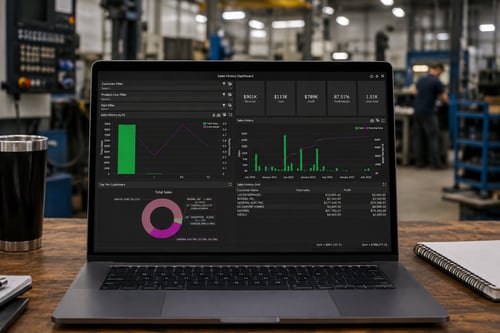
Quote-to-cash cycle time measures how long it takes to move from customer quote to payment. Delays in quoting, order entry, production, shipping or invoicing can slow cash flow.
Integrated shop floor software helps shorten the cycle by connecting quoting, scheduling, production, inventory, shipping and accounting activity.
How to measure it: Payment received date − quote date
Why it proves ROI: A shorter quote-to-cash cycle improves cash flow and shows the value of connected operations management.
11. Improve real-time reporting access
Real-time reporting access measures how quickly leaders can get the information they need to make decisions. Before shop floor software, reports may take hours to build and may already be outdated by the time they are finished.
With real-time reporting, leaders can quickly see production status, inventory levels, job costs, labor efficiency, quality trends and plant performance.
How to measure it: Previous report preparation time − current report preparation time
Why it proves ROI: Faster reporting reduces manual work and helps leaders make decisions based on current data.
Ready to see how Global Shop Solutions can help you prove ROI across your shop floor? Schedule a demo to learn how real-time data, multi-site visibility and integrated operations management can help improve plant performance from quote to cash.