Archive for February, 2008

Value Stream Mapping: Knowing Where You Are When You’re There

Monday, February 25th, 2008

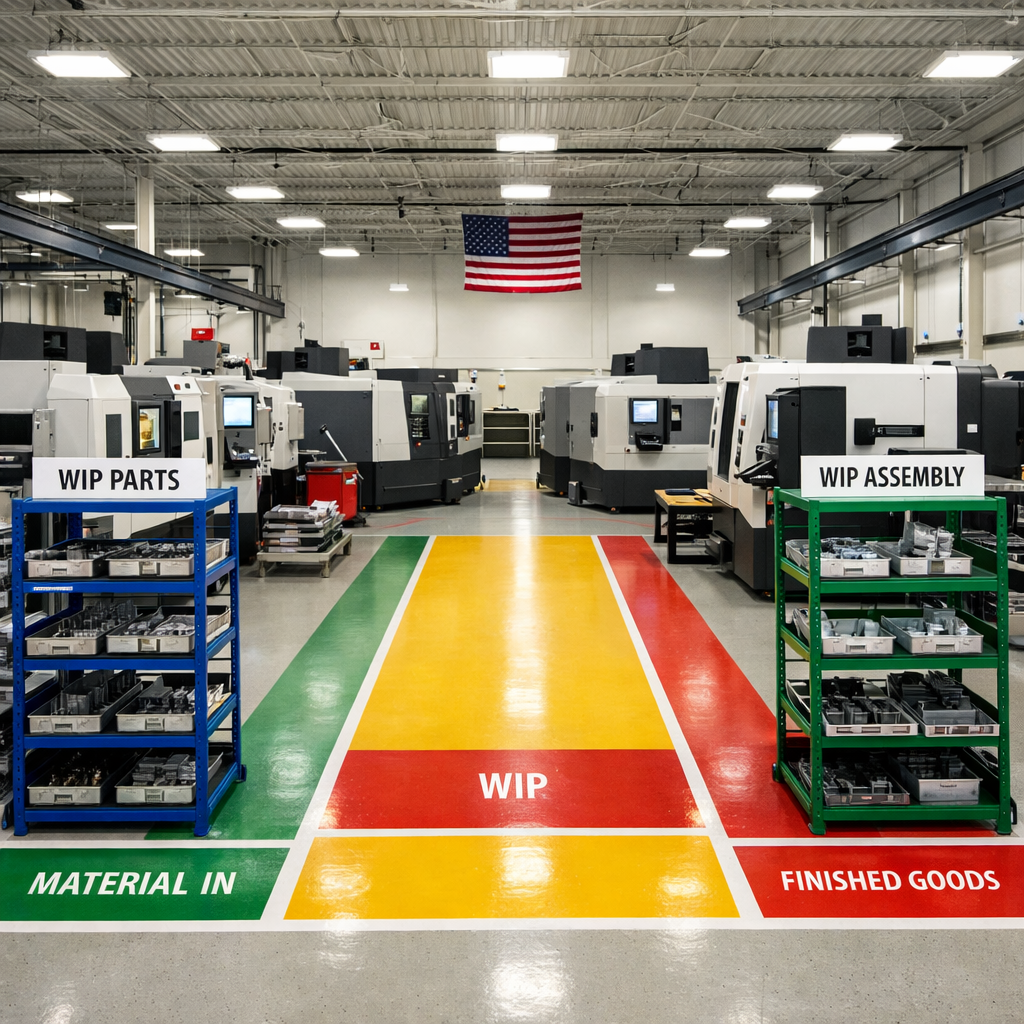
The modus operandi of a fast-food hamburger joint is to have a burger already prepared and ready to go when or if a customer asks for it. The bad news here, of course, is that without some sense of how long a particular burger may have been in the “finished goods” inventory (i.e., under the red lamps), there is the distinct possibility that your product may be cold and obsolete by the time you receive and consume it.

On the other hand, at some fancy-schmancy gourmet-burger place, where all is custom and only made once the order is in and confirmed, you may have quite a wait between placing your purchase order and taking delivery of the product. In each operation, the inherent pitfalls of inventory management are factors of lead time—with fast food, too much of it, and gourmet not enough.

To bring a product or service to a customer requires not only the material in which to do it, but information that will give a sense of what and when that material will be needed. In short, efficient manufacturing requires that (more…)

One-Piece Flow Manufacturing

Monday, February 18th, 2008

What is manufacturing without motion? Not much, really. In a 24 – 7 world where time is a boundless concept, and the ability to profitably produce is determined by the maximization of capacity, remaining in motion is often the key to success for any manufacturer. To be sure, this concept of motion is not to be confused with the quantitative output of inferior products merely for the sake of meeting output quotas.

To the extent that output is the result of a combination of quantity and quality, this means that capacity is maximized and customer satisfaction maintained. In short, motion is central to manufacturing, and the more continuous it is the better. To this end, the concept of cell-system manufacturing was developed to produce the best quality product in the most efficient possible way.

The idea behind cell-system production is to provide a continuous flow of produced goods through the absence of delays in the process. It is a notion of producing one quality item at a time, and to have those items continuously moving off the production line and in route to the customer—in short, one-piece flow.

Central to the idea of one-piece flow manufacturing is the concept (more…)

Cost Assignment Models ~ An Overview

Monday, February 11th, 2008

Remember when it was just you, your garage, and a single fabricating job each week from that one company who saw potential in your work? Costing, for you then, was simply a matter of getting the work done as quickly as possible with the lowest investment in material and no inventory at all. Talk about “just in time” production. Often it was more like “just in in the nick of time” when it came to getting in another work order to keep the electricity on or bread on the table.

My, how things have changed as you’ve grown into a 60,000 square foot job shop with 80 employees, and dozens of work orders coming in each day. What used to be a simple costing formula (i.e., price charged – material cost = profit), involves so many variables it can make your head spin.

Of course, you wouldn’t have gotten to this point without a progressive improvement in the way you assigned costs to jobs. You came to understand that costs include more than just materials; they include (more…)

Just-In-Time: Making a Point of JIT

Monday, February 4th, 2008

What could be better than being just in time for somewhere you were scheduled to be or a task you had to do? That is to say, you were not too early on arrival, wasting valuable time standing around doing nothing. Nor were you too late to the task, not being able to complete on schedule that which you were asked to do.

In short, wouldn’t it be the best case scenario for you to produce the right task at precisely the right time to maximize both your time and productivity? This notion is the concept behind the philosophy of lean manufacturing referred to as “just-in-time”, or JIT production.

In JIT production, we are seeking to eliminate costs that add no value to the final product. It is certain that without critical thought applied to a manufacturing system as a whole, the potential for waste in process is heightened. These forms of waste can include (more…)