Archive for the ‘Labor and Payroll’ Category

Trust Global Shop for Increased Sales Webcast on February 6, 2013

Friday, February 1st, 2013

On February 6th Global Shop Solutions will be giving our first quarterly webcast. Each quarter, one of these webcasts will be highlighting a business goal and, how Global Shop One-System ERP Solutions™ can help businesses achieve that goal. This week’s topic is “Trust Global Shop for Increased Sales.” (more…)

Buy Smarter (and Cheaper) with Automated Purchasing

Monday, January 28th, 2013

Purchasing is highly efficient in Global Shop’s ERP Software. GS Automated Purchasing users experience streamlined inventory management and time spent on purchasing is cut in half! Through the use of these three innovative tools companies are fully capable of streamlining their purchasing system (more…)

Shop Labor: The Cost Reduction Tipping Point

Monday, May 2nd, 2011

Can ERP really improve shop labor performance, making a big difference on cost, quality and on-time delivery? Yes, a lot more than you think. Envision a shop where all clock (payroll) time is accounted for on a job, whether direct or indirect, and there is almost no input – only biometric identification and selection of the job recommended on a touch screen. All documentation, including prints, quality instructions, setup sheets, are at your fingertips. Some companies experience a 25% improvement in labor costs, typically resulting in enhanced on-time delivery and improved quality.

Here is where many manufacturers using enterprise resource planning software (ERP) realize their quickest and biggest return on investment. How? (more…)

Find ISO-Compliance Quality at Your Fingertips with ERP

Monday, April 4th, 2011

Is it possible to get a complete, fully integrated enterprise resource planning (ERP) software package where the whole process is ISO and QS-9000 compliant? They’re some ERP systems out there that do this, and through them you can achieve the sort of compliance levels you need to document and exhibit ISO and QS-9000. Or, rather, you should be able to do so.

ISO certification requires documenting what you do and proving that you do what you document. Some ERP software has complete traceability including lot, heat and serial number for getting a real edge on quality audits. You can also catch non-performance before it really starts on designated screens in real-time or on each day’s early morning reports. (more…)

Principles of Discrete Manufacturing & ERP

Monday, July 12th, 2010

When you form solid raw materials to produce things you can easily touch, see, and/or count, you are most likely what is called a discrete manufacturer. Discrete manufacturing is often characterized by the making of individual or separate units, which is typically low in volume and very high in complexity. That is to say, in discrete manufacturing you are often either building single parts or assemblies of several other parts, with such assemblies often themselves even going into the manufacture of ever more complex products or machines.

This concept is distinguished from what is called a process manufacturing model that often involves notions such as formulas and mixing. Such process can be found in the production of items such as pharmaceuticals, fertilizers, foodstuffs, petroleum products, and so forth. (more…)

Choosing the Best ERP System

Monday, April 26th, 2010

With so many different ERP systems to choose from, identifying the right software package can be a daunting and time-consuming task. However, given the cost, integration and long-term impact of ERP systems, you can’t invest too much time in the evaluation process.

The best approach involves using one of several online tools to sift through all the different vendors and narrow the list down to three to five finalists. Once you have a short list of finalists, conduct extensive interviews with each company and “demo” their software to see which one best fits your needs. Be sure to ask each company to come to your location for a test run. If they insist that you demo the software at their site, it should raise a red flag about their approach to customer service.

When evaluating different packages, look for the “four C’s” of an ERP system: (more…)

Looking at Performance Measurements In Manufacturing

Monday, February 8th, 2010

How do you gauge success in manufacturing? Most would say it’s a factor of profitability, and of course, they would be correct. But, when it gets to the nitty-gritty of making sure profitability is running full-speed ahead, shop performance is going to have a great bearing on just how that profitability is achieved.

Certainly, when it comes to the investment you might make in an enterprise resource planning system (ERP), performance measurement is going to be considered the biggest payback area you can achieve. The stronger an ERP system is in being able to measure performance on a wide variety of cross-operation variables, the better informed you will be about what’s going on within your production area — and where the best improvements will realize the greatest returns in profitability.  (more…)

Getting ERP Right (A Primer): Part 1

Monday, December 7th, 2009

Manufacturing in the U.S. is getting tougher all the time and the pressure is unrelenting. To remain competitive, you must continually cut costs, increase productivity and improve quality, while at the same time offering better service, faster delivery and lower prices. Fortunately, there is a tool to help you accomplish all this and more.

You’ve probably heard about enterprise resource planning (ERP,) the manufacturing planning approach that cuts cost and boosts productivity by integrating all your production processes into one cohesive system. You’ve probably heard that it can improve on-time deliveries and inventory control while simultaneously reducing administrative overhead. That it can streamline all of your manufacturing processes by increasing visibility throughout the organization. And that it can turn inefficient companies with high cost structures into lean, mean operations that can compete with anyone in the world. (more…)

Discovering Your Shop Floor Efficiency—or Inefficiency

Monday, October 12th, 2009

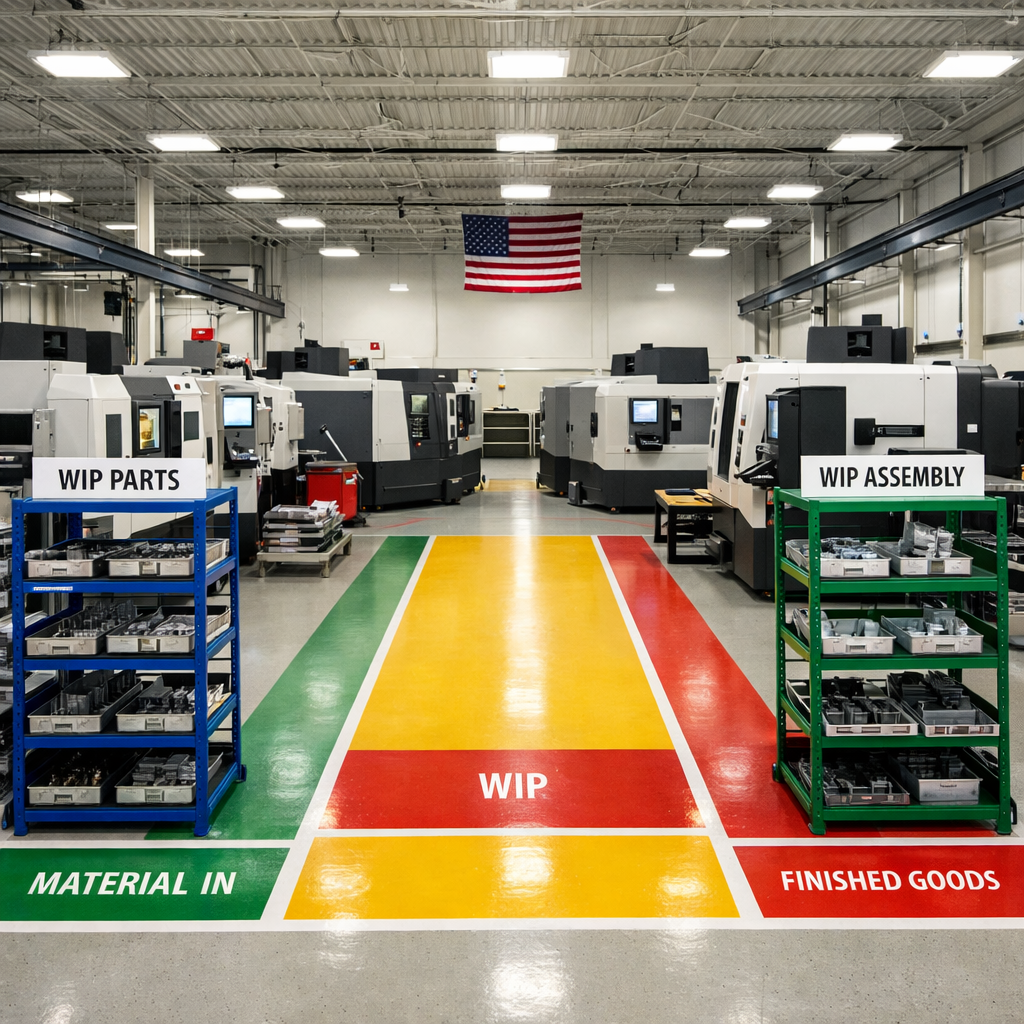
As your manufacturing operation grows, finding out just how efficient you are operating gets harder and harder. To be sure, when your sales increase work in progress (WIP) increases, and inventory turnaround often diminishes.  Discovering how efficient or profitable each process becomes an ever-elusive notion. To a certain degree, enterprise resource planning software (ERP) has helped in providing a continuous status assessment via the input of real time data from all operation aspects. ERP software, for this reason, is a valuable tool for the continuous improvement necessary for the modern lean manufacturer.

In short: You and your company need some continuous assessment of core process performance for the purposes of building continuous improvement throughout your system. It is for this very reason that lean metrics have been established to measure, evaluate, and respond to performance levels in such a way that it does not sacrifice quality to satisfy quantity objectives, or increase inventory levels to achieve machine efficiencies. To use lean metrics is to discover lean efficiency indicators (LEI) that tell the tale of ERP implementation effectiveness. (more…)

Cell-System Manufacturing

Monday, September 14th, 2009

Building the most fluid production line has been the goal of manufacturers since time in memoriam. In the modern global economy, where the notion of time has vanished leaving only “now”, success is measure by speed. Depending upon your product, geography even doesn’t make that much of a difference anymore. Transportation and on-shore production have been practically elevated to the level of business arts. To keep the pace, manufacturers must remain moving, and produce quality goods while in motion.

One of the best fitting models for producers today is cell-system manufacturing. Efficient and completely scalable, cell-system manufacturing is an efficient means to provide a continuous flow of produced quality goods as individual pieces, and to have those items continuously moving off the production line and in route to the customer. Also referred to as one-piece flow production, the core value of the model is the concept of motion—motion of materials, motion of parts/assemblies, motion of personnel, and the motion of finished goods out of the plant. (more…)