Archive for the ‘Shop Floor’ Category

Take Control of Your Shop Floor

Monday, March 4th, 2013

In today’s environment, enterprises must operate “lean and mean” in order to compete. This requires having a firm grip on every aspect of the business, not just the shop floor. Global Shop Solutions has the software tools to streamline your company’s operations (more…)

Trust Global Shop for Increased Sales Webcast on February 6, 2013

Friday, February 1st, 2013

On February 6th Global Shop Solutions will be giving our first quarterly webcast. Each quarter, one of these webcasts will be highlighting a business goal and, how Global Shop One-System ERP Solutions™ can help businesses achieve that goal. This week’s topic is “Trust Global Shop for Increased Sales.” (more…)

Integrated Single System ERP Software

Monday, May 16th, 2011

Why is having a single system enterprise resource planning (ERP) software solution the most desirable approach to manufacturing control? The answer is simple, but not always evident: It’s because everyone gets on the same page. Data gets entered one time and one time only. Time is not wasted trying to find information. You see the whole picture so that you can spend your time improving the business and increasing sales.

It starts with generating an estimate, which in most cases, only takes a few seconds. Then a customer quote with automatic multiple requests for vendor quotes. Upon receipt of the order, a sales order gets generated with a few keystrokes. (more…)

Shop Labor: The Cost Reduction Tipping Point

Monday, May 2nd, 2011

Can ERP really improve shop labor performance, making a big difference on cost, quality and on-time delivery? Yes, a lot more than you think. Envision a shop where all clock (payroll) time is accounted for on a job, whether direct or indirect, and there is almost no input – only biometric identification and selection of the job recommended on a touch screen. All documentation, including prints, quality instructions, setup sheets, are at your fingertips. Some companies experience a 25% improvement in labor costs, typically resulting in enhanced on-time delivery and improved quality.

Here is where many manufacturers using enterprise resource planning software (ERP) realize their quickest and biggest return on investment. How? (more…)

The ERP Need

Monday, March 7th, 2011

Living in the Internet Age has meant a couple of things: Living faster, and doing business much differently. Small and medium-sized businesses, in particular, may be feeling the greatest impact. With advances in technology breaking down geographic barriers, even companies with just a few million dollars in annual revenue find themselves operating on a global scale, with customers, suppliers, and other business partners located the world over.

Most small business owners welcome these changes because they have given them access to markets that previously were open only to the largest corporations. On the other hand, small business owners are realizing that competing with mega-enterprises for access to markets also forces them to deal with many of the same problems that confront big organizations. (more…)

Small Business ERP

Monday, February 21st, 2011

Nothing’s small when you own and operate a small business. This is especially true when your small business just happens to be in the manufacturing sector. Small manufacturers encounter many of the same challenges that medium and large companies do, including pressure from competitors; global economic volatility; the need to attract and retain new customers; and the need to reduce expenses and increase profitability.

However, many small manufacturers have myriad other issues to contend with that big businesses don’t have, or have an easier time facilitating by virtue of economic scaling. Certainly, in today’s tight credit markets, limited access to financial resources is a key hurdle for small businesses. This is exacerbated by increasingly higher operational costs and the constant difficulty in finding qualified people to work for you. (more…)

Manufacturing Management Models

Monday, January 31st, 2011

Are the functions of a manager truly different in a lean manufacturing environment when compared with a traditional management structure? Of course they are. It is all a matter of the degree to which each incorporates production variables of their specific models that they will differ in some ways, and don’t differ very much at all in other ways. It’s important, though, to understand these differences for seeing what model—lean or traditional—works best in your own shop for managing people and processes.

So what are the differences? In a lean manufacturing environment production is based on real customer demand. In a traditional manufacturing environment production is based on what you hope to sell. (more…)

Your Manufacturing Work Environment: Signs, Signs, and More Signs

Monday, January 17th, 2011

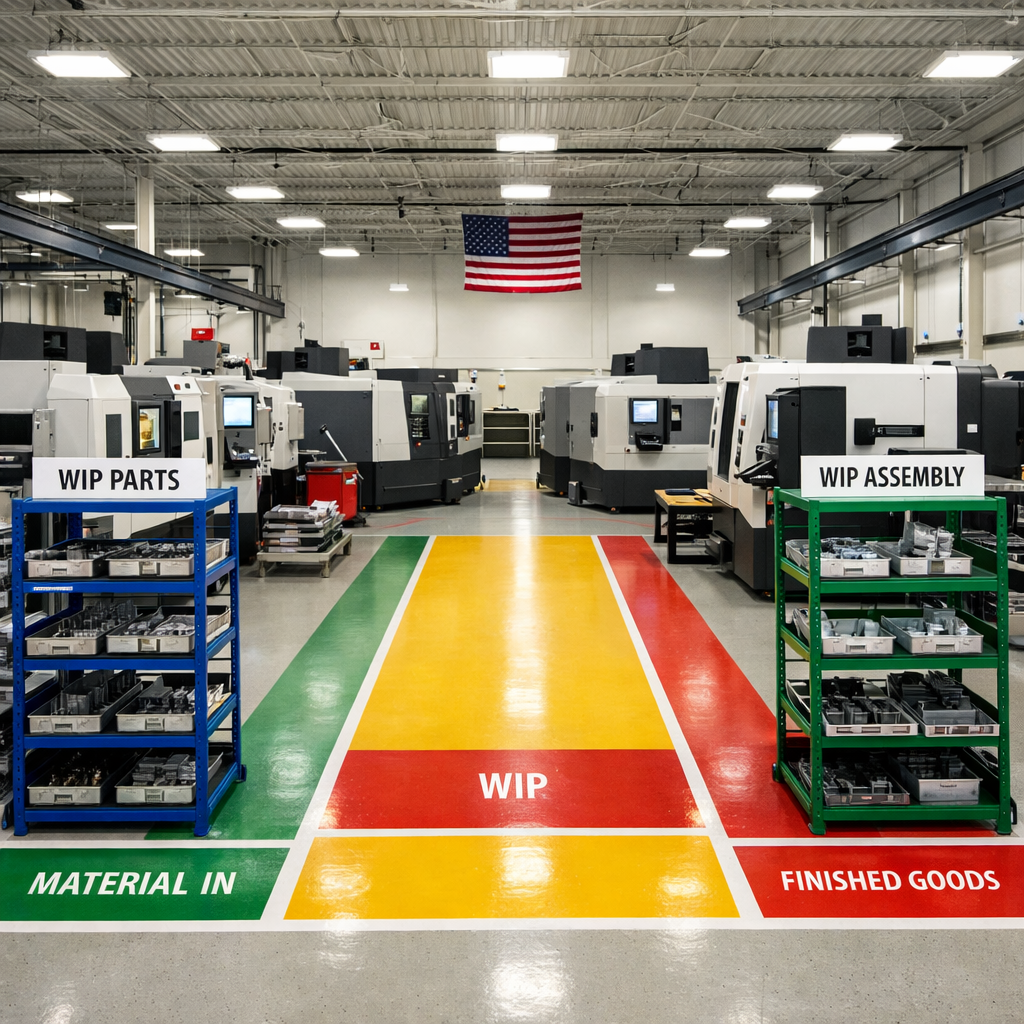
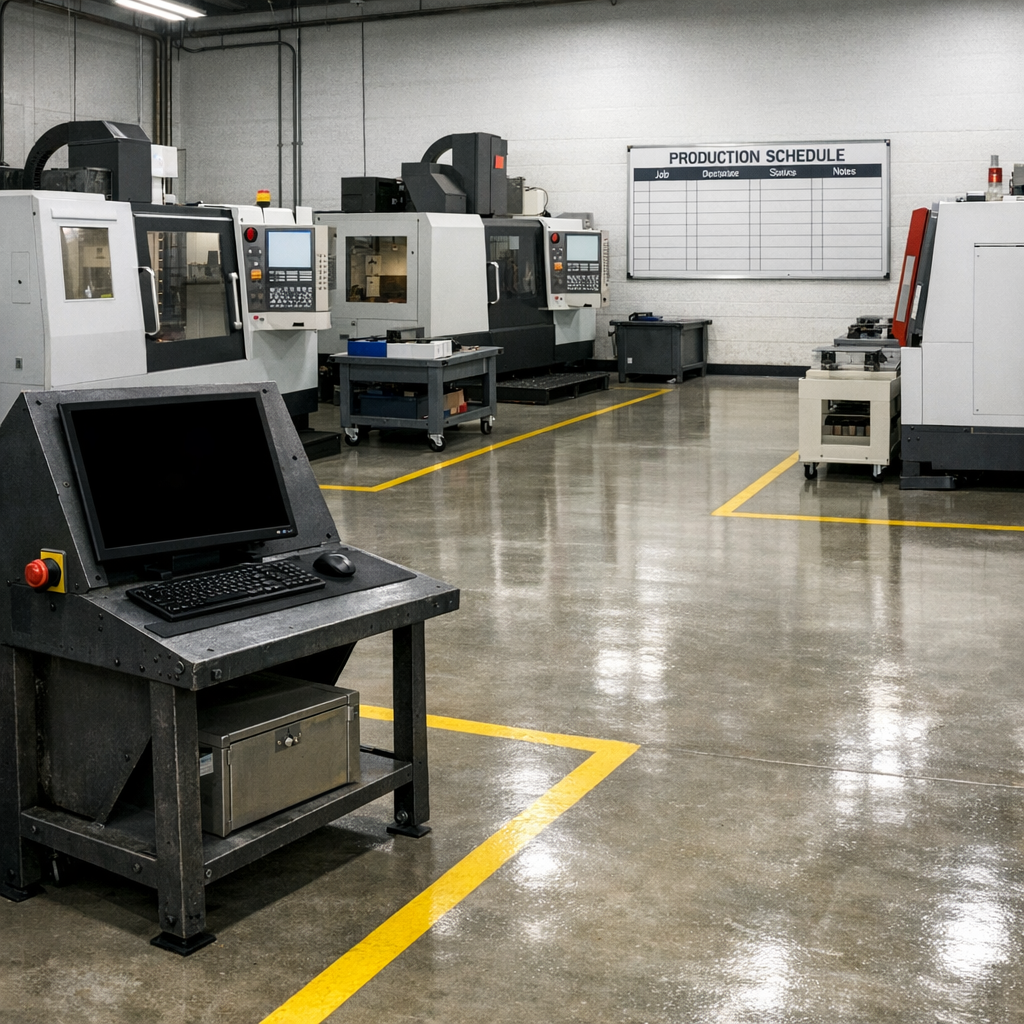
Take a walk out onto your shop floor and really look around. I mean, take a short, sharp look at what’s going on. If you have your eyes opened objectively, the shop floor should be telling you everything you need to know about your company. It will tell you what your operators and managers are thinking about their tasks and their company. It will also tell you what your position is relative to your competition, your level of quality, and, most importantly, what kind of business associate you are considered to be by your customers and prospects.

Is your work place—for want of a better word—disheveled? Cluttered, dirty, unsafe, and disorganized. Are machines dripping all over the place, lines snaking across the floor, work orders barely readable through yellowing plastic travelers, tools stacked on workbenches, and operators strolling about in search of tools that should have been accessed in a matter of seconds? (more…)

Lean Manufacturing Throughput

Monday, December 27th, 2010

The sales order comes in, the work orders go out. Schedules are made, capacity planned. At some point, you make a decision about what the period of time will be required for that part, material, or subassembly to pass through the manufacturing process. In short, you’ve calculated the throughput time. Why is knowing your throughput time important? Well, it’s like asking why cities time their traffic lights, or why can’t all surfers ride the same wave in the same spot. At some point, without knowing your throughput time, all flowing elements will converge on the same spot and produce an intractable bottleneck that halts production, driving, surfing.

Throughput time is a lean concept, and it’s always important to clearly understand the advantages of lean manufacturing before it is implemented. One of the most important advantages of being lean is the ability to provide goods to the customer with shorter lead times. Of course, lead time is often the result of many factors and components. Throughput time (TPT) is one such component lead time. It is a notion every manufacturer gives critical attention in the manufacturing process. (more…)

An Overview of Job Shop Tracking Software

Monday, December 13th, 2010

By their nature, job shops are often, as they say, “all over the place” with what they do. Usually, they have to perform multiple tasks with limited resources. Diverse orders come and go with great speed. Their production requirements are such that each order could be something new, with engineering changes often coming on the heels of the order submission to the floor. With so much coming and going, scheduling and tracking is a vital function in job shops. When an order is delayed or otherwise neglected, there are usually heavy costs associated with it—loss of revenue, loss of material, loss of time, and loss of customers. It’s that last one that’s the real biggie.

Tracking software enables companies to track production items from sales order to shipping (and sometimes beyond), and also identify their costs. This type of manufacturing tool works real-time to track and record each and every transaction within the process, ensuring accountability for all the resources that are used in the job shop. In the best systems that are part of larger enterprise resource planning (ERP) software systems, everything in the job shop can be tracked—from the labor and resources used for the job, to the status of the job, and the status of the shipment. (more…)